

Recently a group of teaching elders, members, and people in “other leadership role”s in the Presbyterian Church in America published a “Call to Prayer & Lament.” This document lays out a series of complaints against the PCA.
“But Andrew,” you ask, “You are not in the PCA, why do you care?” There are a few reasons. First, I was once in the PCA. I initially began preparing and studying for ministry in the PCA. However, it soon became clear to me that the many in the PCA were not interested in addressing the progressive creep within the denomination. At the time I went to seminary, Revoice was at its peak and racial grievance and soft egalitarianism were making inroads. I also learned over time that, sadly, my own commitments to confessional Reformed theology were a bit too serious and intense for much of the PCA to stomach. I say this knowing that there are many good and faithful confessional brothers in the PCA, but I made my choice. The fact that many of the same problems are still plaguing the PCA, dare I say, somewhat vindicates my decision.
But that is not why I care or write about the PCA. While I do not serve in the PCA, the truth is that our denominations are intertwined. The OPC and PCA have joint ventures in Christian Education and frequently collaborate on missions and other endeavors. Many ministers move back and forth between our denominations. Because the PCA is nearly ten times larger than the OPC, it exercises outsized influence on seminaries and other institutions and organizations that serve both of us. I don’t know who first said it, but I find the saying to be true that “when the PCA sneezes, NAPARC catches a cold.” The PCA’s difficulties inevitably become ours.
This is a problem given that, in my estimation, the PCA has been at least two denominations for many years now. When I was a member, I was a part of a relatively small, confessional, traditional congregation in a small city. When I would travel I would visit other PCAs and find basically the evangelical megachurch experience that I thought I had escaped from when I embraced Reformed faith and practice. It was then I began to realize there were two PCAs. On the one side, you have those who tend towards smaller congregations, regulated worship, committed confessionalism, by-the-book polity, and political and social conservatism. On the other you tend to have large urban and college town churches with normative worship (praise bands, anyone?), more permissive interpretations of confessions and polity, and progressive (or at least progressive-sympathetic) political and social stances. I suspect the former likely constitutes a majority of the congregations and membership but the latter has a majority of the money, influence, and institutional control. A good litmus test to determine which side you are dealing with is to ask what they think of Tim Keller (hint: the former will be bearish and the latter bullish. This is an iron law.)
One of the signers of the “Call” was Irwyn Ince, who until recently was the director of Mission to North America, the PCA’s domestic missions agency. Other initial signatories (Kellie Brown, Owen Lee, Robert Blevins, and Charles McKnight) are listed on the MNA website as staff members.
This “Call to Prayer and Lament” is clearly written from a progressive framing. This is clear in its statements on race. Among other things, it laments:
Many of us and those we serve have been persistently excluded, questioned, or sidelined because of our race, gender, or cultural background, and because of the way our convictions and ministry methodologies are at times discordant with the white and male-dominant culture that is normative in the PCA.
This is the typical sort of language of progressive racial grievance that has characterized not only the PCA but much of society and culture in recent years. Ince came under fire this summer for appearing at a racially segregated event held at a PCA church while he was still MNA director. He has made (dare I say, racist) comments questioning the care and safety of black persons serving in predominantly white ministry environments. An attempt was made to address this from the floor of this year’s General Assembly when Ince’s re-election was before the body, but something something decorum, thank you, Kevin DeYoung. The “Call” grieves “the absence of leaders of color at the national level in the PCA.” Again, one of the signers held a national agency head position in the PCA until his recent resignation. Others on the list have also seemingly had no shortage of employment and prominence within the PCA and adjacent parachurch organizations. What more could the lamenters be asking for that they do not already have?1
The statement is also egalitarian. It attempts to frame itself as complementarian (not that complementarianism means much anymore), but the proof is in the pudding. It comes on the heels of the #SaveThePCA investigation which has exposed many PCA congregations of the progressive persuasion as having functional female officers. The women who signed this statement listed as “other leadership role.” Given that leadership, the office of rule, is committed biblically to qualified elders, alarm bells ought to be going off. Again, at least one of the women who signed the statement already holds a staff position within a PCA agency. How then, is she “sidelined because of…gender”? What remains to create “a spiritual family where women are empowered”? The only glass ceiling that is really left to shatter in the PCA is that of ordained office and the functions, roles, and privileges limited to ordained office.
The statement is pro-LGBT. It laments how “The very neighbors we are seeking to love — secular, progressive non-Christians, LGTBQ [sic] individuals, immigrants, people of color, and more — are publicly belittled and demonized, if not by our words then by our legislative actions.” Further, “We continue to long for an ecclesial home where…Those wrestling with complex identities and callings find safety, truth, and grace.” I would be curious what “legislative actions” they find objectionable. As I said earlier, the Revoice controversy played a part in my decision to leave the PCA. Greg Johnson, a PCA minister who identified as a homosexual, was never (to my knowledge) convicted in any PCA court of an offense in doctrine and life, and was free to leave as a minister in good standing (I don’t think this was a good thing, but them’s the breaks). Some amendments to the PCA’s Book of Church Order were made that make it more difficult for homosexuals to hold office. Again, what more do the lamenters want? Do they want homosexuals to be affirmed, even to the point where they can hold office? Because if so, they probably are not a good fit in a church that holds that homosexuality is a sin2 and thus bars homosexuals from office. These are the kind of debates currently dominating mainline churches (see the recent assemblies of the Christian Reformed Church, the Presbyterian Church [USA], and the United Methodist Church), not the ones who ostensibly left the mainline over 50 years ago.
So the statement is not good. But so what? As I stated earlier, I think the PCA has been at least two denominations for quite some time. At some point the differences are of such substance that a church cannot continue in peace and purity as long as they remain. That leaves grim options. Those who hold to the unbiblical and offending views could face church discipline unto either repentance (preferred) or removal. Given how the statement declares that “Some” (who?) “have described the denominational environment as emotionally or spiritually abusive, particularly toward leaders from marginalized and/or minority backgrounds” and it laments “doctrinal gatekeeping and judicial processes that drain energy from mission and ministry,” there seems to be an unwillingness on the parts of the authors to submit to judicial process (which itself is a violation of the PCA’s membership and ordination vows). Furthermore, there has to be a willingness on the part of the PCA’s presbyters and courts to actually initiate such a process and see it through when there are obvious and public sins and infractions occurring. There are times to amend the BCO but there are also times to put the BCO to work. And it is not merely enough for there to be process, the process must come to righteous, just, and biblical conclusions that allow the church to continue in peace and purity. The church courts cannot declare “‘Peace, peace!’ when there is no peace” (Jer. 6:14).
That’s one grim option, likely an unpopular one. But what is the other? If the PCA is not willing to do what is necessary to guard the peace and purity of the church, then there will only be more and greater disagreement and degradation, and inevitably separation. The two functional denominations will become at least two actual denominations. The issues that plague the PCA now are the ones that have been lines of fellowship many times in many other churches in recent history. The PCA initially separated from the PCUS in part over the women in office issue. The CRC was expelled from NAPARC (and the URCNA separated from it) when it began ordaining women as ministers and elders. The churches that would not hold the line on women in office have inevitably turned to issues of homosexuals in office and more. These are not agree-to-disagree issues. For many (myself included), they are inviolable markers of faithfulness to God’s word and the truth of Christian profession.
You can put oil and water in a bottle, but they cannot mix and you will still have oil and water. You can try to put the pieces two puzzles in the same box and mix them up, but at the end of the day you still have two puzzles. Similarly, you can put confessional, conservative Presbyterians and egalitarian, progressive evangelicals in the same visible church, but you will never have true peace, purity, and unity among them. Some things just don’t belong together.
Image: Richard Pope, used under CC BY-SA 2.0 license. Division Bells are located near the UK parliament to alert members that it is time to vote.
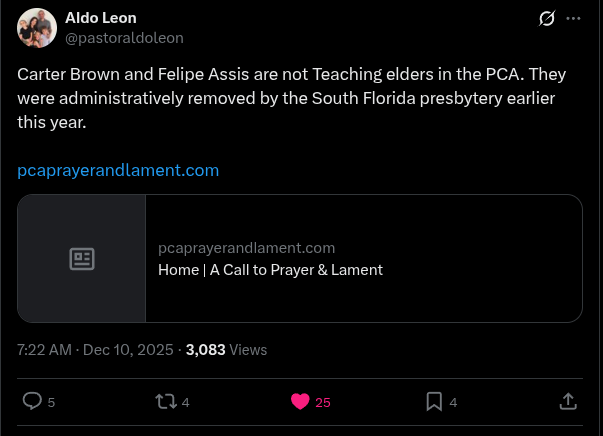
Update and correction Dec. 10, 2025: Pastor Aldo Leon revealed that two of the original signatories, Carter Brown and Felipe Assis were administratively divested from being PCA Teaching Elders, earlier this year. I initially included this as an update in the article.
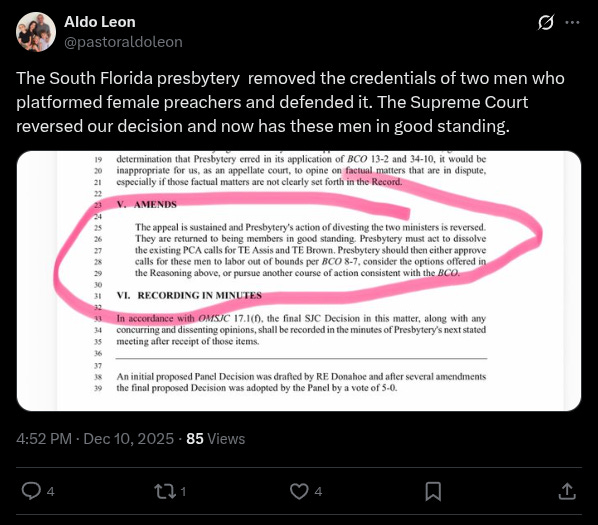
Rev. Leon provided an update later in the day that the PCA’s Standing Judicial Commission reversed this decision and reinstated them
I apologize for reporting and commenting on the outdated information.
Update 12/11/25: Rev. Leon provided a further description of the process.
This is a really good word.
I suspect that the divide began with the receiving of the RPCES in 1983. The joining of the larger conservative churches to the young PCA produced growing pains unlike any that the OPC has endured. The schism back at the beginning strengthened the OPC. An eventful split of the PCA will strengthen it.
On a historical and personal note, my grandfather was Samuel J. Allen, was a protege of J. Gresham Machen, and founding father of the OPC. A minister of the PCUSA, he left for the OPC. He would minister in the PCUSA after that. He founded a church the year of his death in 1954 which was later a founding member of the PCA.
He left the OPC over what he saw as a continuing attitude towards the Fundamentalists of the original schism. Search the Archive for his Seven letters to the Church.