

This originally appeared as two threads on X on July 26, 2024
Of course those who most benefit from accreditation will present the rosiest view of it, even invoking it as a marker of “true” education. heidelblog.net/2024/07/educat…
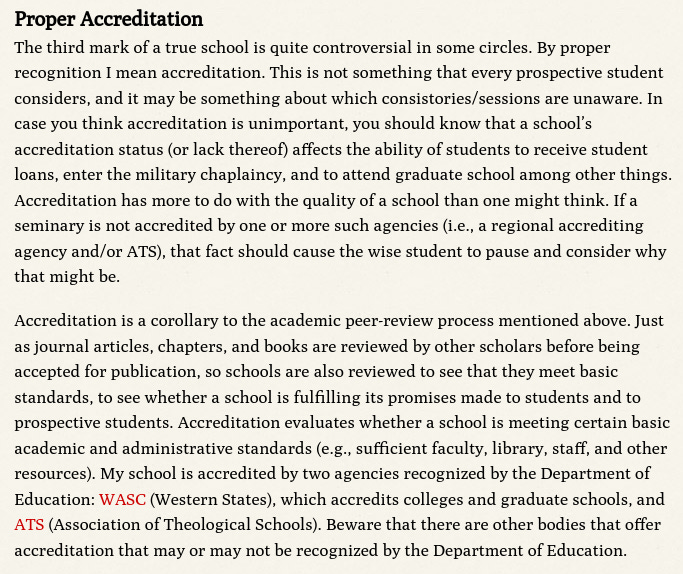
I did a deep dive about a year ago into the problems with ATS accreditation particularly: how it invites doctrinal compromise, how it prioritizes the interests of academia over the church, and how it furthers a DEI agenda.
I haven’t looked as deeply into regional accreditation, but from the little I’ve seen, because these bodies accredit all kinds of schools, they are even more deeply captured by godless ideology than ATS.
Leaning on something like accrediting NGOs to be a marker of good schools vs. bad schools (or, to use Clark’s own language, true vs. false) is a terminal case of failure to recognize what time it is.
For those who don’t want to sit through a whole hour of me talking about the problems with ATS accreditation, let me give you some highlights.
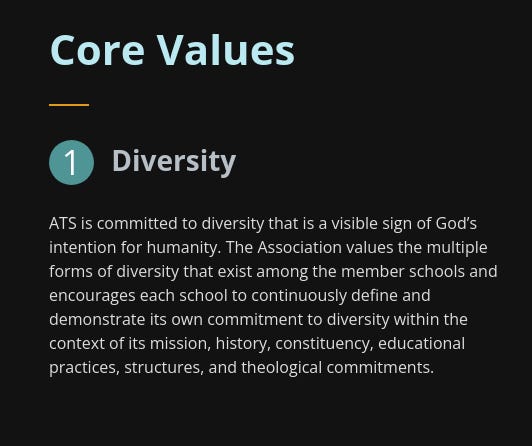
ATS lists diversity as its #1 core value. Before “Quality and Improvement” (#2), “Collegiality” (#3), and “Leadership” (#4). ats.edu/About-ATS
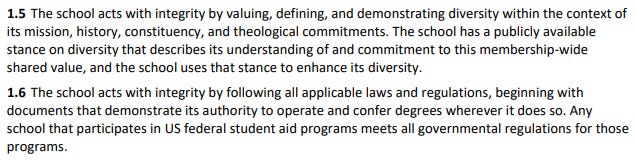
The ATS Standards of Accreditation impose many diversity-related requirements on schools as a demand of “integrity.”ats.edu/files/gallerie…
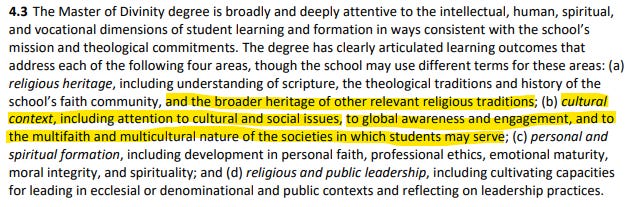
MDivs are to require engagement with other religious traditions, and preparation for “the multifaith and multicultural nature of the societies in which students may serve...”
Faculty must be demographically diverse, must be granted freedom of inquiry, and students’ diversities must be respected.


The ATS has a Women in Leadership initiative that seeks to increase the number of women who serve as faculty and administration in theological education.
Women in Leadership https://www.ats.edu/Women-in-Leadership
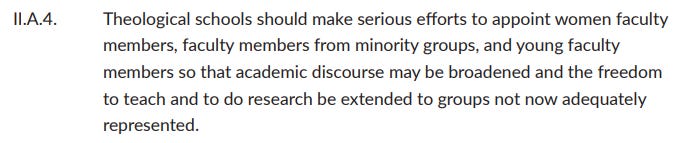
Also, in their Policy Guidelines, ATS expects member schools to appoint women as faculty, as well as minorities and young faculty. ats.edu/files/gallerie…
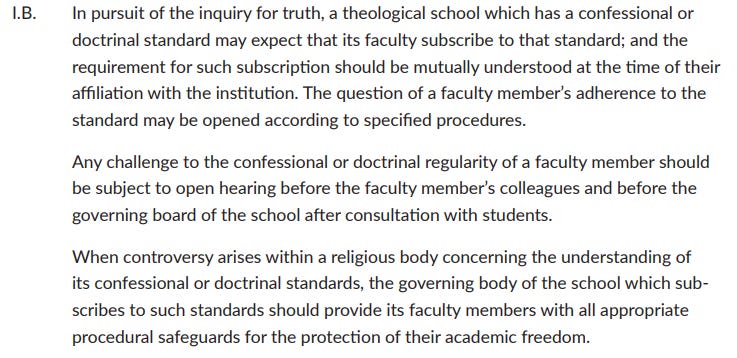
Also in Policy Guidelines, ATS requires schools to protect academic freedom of professors when confessional and ecclesiastical disputes arise. Might explain how seminaries seem to circle the wagons when their faculty come under fire for their teachings.
ATS Policy Guidelines also prohibit churches from accrediting schools. It seems they do not think anyone but peer academics are up to the task.

Ask yourself: what is this organization doing that makes it (or something like it) a prerequisite for “true” theological education? It creates bureaucracies, it creates the preconditions for doctrinal and mission drift, it creates jobs for preferred classes, it protects heterodox professors from the consequences of their actions, but none of this makes theological education “true” or even better. From where I’m standing, ATS looks like another tentacle of the regime reaching into the church.