

Over the past weekend, George Sayour of the Grace at the Gates podcast posted a discussion with James Baird (PCA minister and author of the recent book King of Kings) and Daryl G. Hart (OPC ruling elder and history professor at Hillsdale College). This comes on the heels of a weekslong contentious back-and-forth on X.
Here’s the video.
I decided to watch and live-post my thoughts on X. But since scrolling X threads is a pain, here’s the whole thing. Timestamps are approximate.
5:00ish
I get not wanting to call it R (for Radical) 2K but there’s also a need to reckon with why that nomenclature has caught on and is so popular. I say this as someone who does not prefer it--I like E (for Escondido) 2K.
7:00ish
But for whatever definition problems E2K has, CN has vastly more, as it seems to be a much more broad movement. George’s is pretty good, I just wonder how many in the “camp” are content with it.
9:00ish
I think a definition of “secular” would be helpful here, because I’m not sure Dr. Hart is quite using it the way most people do.
11:00ish
Question from me: Is limited government a virtue in itself?
(i.e. limited how? What does limitation seek to accomplish? etc.)
Baird has a good point in his answer (founding limited vs. libertarian limited)
13:30ish
This is a problem I see in these debates a lot--start with America and judge theological questions by America’s traditions/standards. I get that we are in America, but America is not immutable/inevitable (see my KDY article from a few weeks back)
14:30ish
Christianity is not entirely reducable to the gospel (soteriology)
17:00
Why prefer neighbors going to Mass over nowhere if it is not promoting Christianity?
I don’t want people going to Mass either, but if we’re admitting it’s better than nothing, then it would seem to still be a point in favor of Sabbath laws.
19:00
For whatever social good Jews have created, Judaism is a false religion, and it seems strange that a Christian would seek to protect/promote it to the same extent as true religion.
21:00
Don’t even get me started on neocons...
22:00
Are they really flourishing? What profit is it to gain the world but lose one’s soul?
23:00
How can a Christian neighbor invite a Jew to church if (as stated before) Sunday is a day of trade/commerce for Jews which they should not be denied.
This seems to be another unintentional point in favor of Sabbath laws.
25:30ish
Abusus non tollit usum
Just because Puritan Massachusetts failed does not mean that it was wrong in how it was conceived or initially conducted.
The same logic could be used to say that COVID tyranny, LGBT, abortion, etc. invalidate American ordered liberty.
I know historians like to very much flex what has happened, but the mere occurrence of something in the past is not an argument for or against something happening in the future; there needs to be particular applications made.
26:45ish
This is key. Basically every critic of every kind of CN has tried to attack a straw man of establishment. Baird is clearly not establishmentarian and yet Hart is unwilling to grant the possibility of this.
29:00 ish.
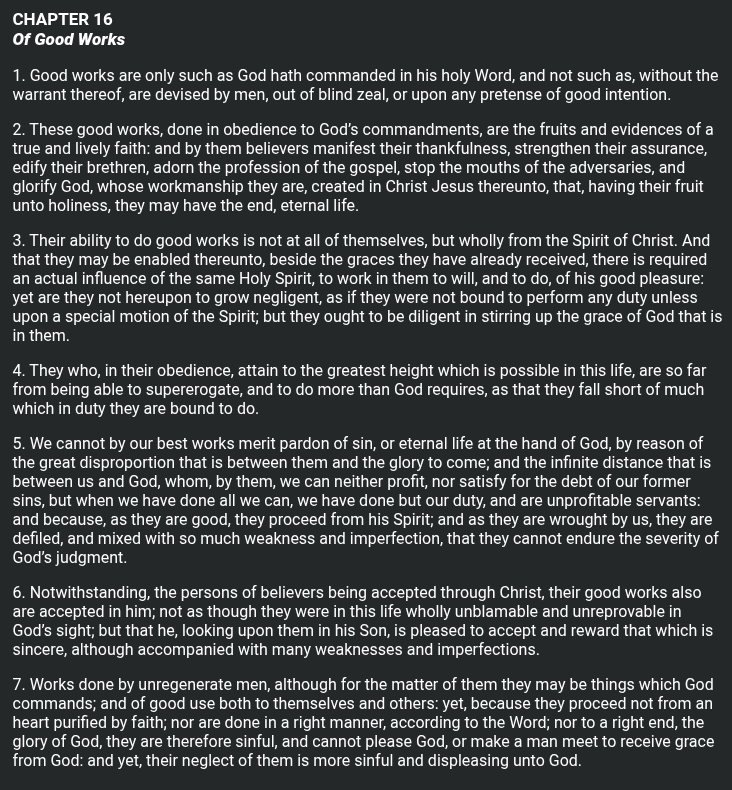
Hart appears to be referencing WCF XVI.7

Notably, these “good” works are not really referred to as good beyond “of good use”--they are called “sinful.” It’s a far cry from virtuous.
32:00ish
Hart here rejecting the notion that only Christians are virtuous.
Again, I think WCF XVI is relevant here, because it seems to indicate that only Christians have even the capacity to do what might be considered (with many caveats) good works.
It should be noted that any non-Christian is automatically obtaining a failing grade in virtue, given that they reject no less than 40% of the moral law by which virtue is defined.
40:00ish
Again, are the First Amendment and American equal protection good ends in themselves?
42:00ish
Suppose science succeeds at its goals and makes artificial means by which homosexuals and transgenders could reproduce? What argument remains, then, against gay mirage in this framing?
43:45ish
“America has a long track record of not making that call.”
OK, but were they right about this?
44:30
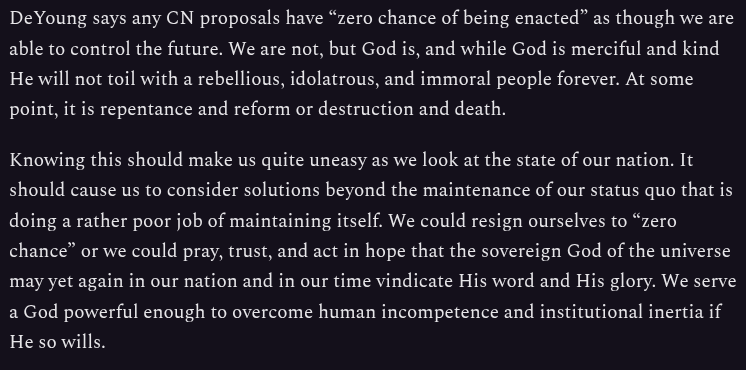
On the “snowball’s chance in hell”
I’ll just leave this here from my DeYoung article.
46:00ish
It seems strange that Hart seemed rather unprepared for this question on LC 108, given that it has been all over these debates. (He seems surprised that that language was in 108)
And no, the OPC does not grant exceptions.
Further, I don’t think abandoning a quest for Christian civic virtue because “snowball’s chance in hell” is particularly heavenly-minded. Why not consider the power of God over all things more in this discussion?
OK, I have to go touch grass. I may or may not return to this later.
Aaaaaand we’re back!
Starting up again around 50:00
50:30
Why didn’t Jesus and the Apostles do everything they could to promote Christianity?
LC 99: “That what God forbids, is at no time to be done; what he commands, is always our duty; and yet every particular duty is not to be done at all times.”
Those apostles weren’t doing much in the political realm during the Incarnation but they wrote a decent amount about it afterwards and in Acts there’s a good many interactions with civil leaders.
52:00ish
It does not seem that Paul appealed to Caesar merely to exercise his rights/overturn his conviction. The case against him was pretty flimsy.
Acts 26:32
“Then Agrippa said to Festus, ‘This man might have been set free if he had not appealed to Caesar.’”
Immediately after, Hart alleges that Jesus and the apostles might be violating LC 108.
See above. This is fairly basic LC interpretation.


54:00
Another problem that the E2K advocates consistently have is they functionally act like only the NT applies to these discussions. It’s a quasi-dispensationalist reading of scripture. Plenty of other churches have it, the Reformed don’t do that here.
In a way it’s worse than that because even the NT texts are only rather selectively utilized and some questionable applications are made.
Thinking of my critique of VanDrunen on Romans 13 from a while back.
https://publish.twitter.com/?url=

56:00
The way the question “Would America be better if everyone worshiped their (pagan) gods?” gets kind of ducked here is telling. DGH very quickly falls back to the America-driven and not biblical/theological driven reasoning.
57:30
It’s really wild to hear a case for how America being in its present state has little to do with moral/spiritual decline. I’d argue (you know, as a Christian and minister) that that may well be the #1 factor with other things being downstream.
I’d really like to hear, for instance, how world wars, etc. brought the sexual revolution.
1:05:00ish
I’m glad DGH sees the difference between these different strains of CN. I’d like to see that better reflected in his engagement on the issue rather than the usual lumping-and-dumping.
1:09:30ish
If Baird’s views are not out of bounds, what has this all been about?
1:11:00ish
Patriotism is another one of these sticky wickets where it’s only as good as its object. We wouldn’t consider it particularly virtuous to be patriotic for Nazi Germany or Soviet Russia.
I think American patriotism ought to recognize what is unique/great/special about America but never at the expense of ignoring/downplaying what is causing us to lose it (and we are presently losing it).
1:15:00ish
Sandi Patty reference

1:15:45
Yes, having multiple loyalties is hard, but every Christian is called to do it and, God helping them, can do it.
1:18:00
Principled pluralism requires principles.
Whose principles?