

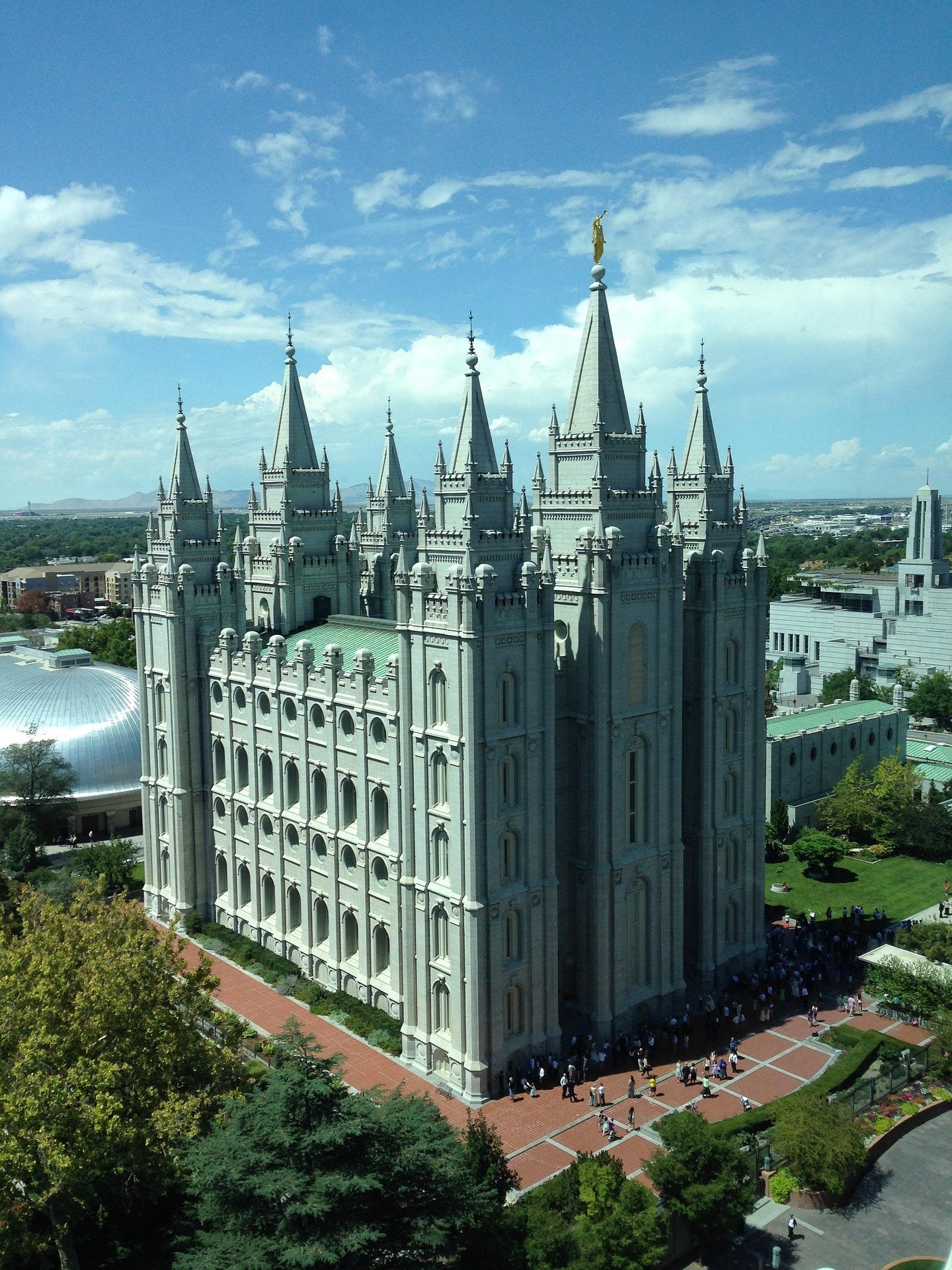
Recently, the U.S. Department of Defense released a new list of recognized religious faiths. On that list, Latter-Day Saints and related groups were not categorized as Christians. This has provoked significant backlash from the LDS (including U.S. Senator Mike Lee, R-UT) who insist that they ought to be regarded as Christian.
Growing up in Wyoming as I did, I frequently came into contact with the LDS and their doctrines and they became an apologetic interest of mine. During my seminary studies, I continued to study these topics and wrote two research papers on matters of LDS doctrine and how they contradict historic Christian doctrine and are themselves internally incoherent. Given the sudden resurgence of interest in Christian/LDS debate, I have decided to publish the first of these papers with minor edits (mostly updating source links to current and non-paywalled versions where possible).
As this paper is from 2018, it might reflect some methods and practices that my readers find unusual. For instance, I made use of modern critical editions of biblical texts (something I no longer do), though in the texts addressed in this essay this makes no significant difference. Without further “adieu” (a word Joseph Smith used very anachronistically in the Book of Mormon), here is “Can Such a World Be?”
Introduction
The Church of Jesus Christ of Latter-Day Saints (LDS) is one of the largest and fastest-growing religious groups in the world. Its founder, Joseph Smith, Jr., sought to bring about a “restored gospel,” free from alleged corruptions by Roman Catholics and Protestants.
As with most religious systems, the LDS faith has wrestled with where the world, the things in the world, and spiritual entities originate from. The LDS church has recently sought to more closely align and identify itself with historic Christianity, demanding careful examination of these issues by Protestants.1 Can LDS beliefs account for the existence of the universe as we know it? Are they compatible with scripture? Do they make proper use of the texts on which they rest? The following analysis will demonstrate that the LDS system not only misuses biblical and other texts it depends on, but also fails to properly account for its own existence. The LDS systems of creation, matter, and eternal progression raise irreconcilable problems, and should be rejected.
Sources of Authority
The LDS hold the following documents to be the written scriptures, or “standard works”: the Bible (as properly translated2,2 with the King James Version as the settled translation), the Book of Mormon, the Doctrine and the Covenants (D&C), and the Pearl of Great Price.3 3 However, scriptural authority in LDS doctrine is not limited to these documents. The LDS teach a doctrine of continuing prophecy, as well as the possibility that additional scriptural sources may emerge in the future. According to the Doctrine and the Covenants:
And, behold, and lo, this is an ensample unto all those who were ordained unto this priesthood, whose mission is appointed unto them to go forth—And this is the ensample unto them, that they shall speak as they are moved upon by the Holy Ghost. And whatsoever they shall speak when moved upon by the Holy Ghost shall be scripture, shall be the will of the Lord, shall be the mind of the Lord, shall be the word of the Lord, shall be the voice of the Lord, and the power of God unto salvation.4
The LDS do not hold their scriptures to be inerrant. The title page of the Book of Mormon states of its contents, “If there are faults, they are the mistakes of men; wherefore condemn not the things of God, that ye may be found spotless at the judgment seat of Christ.” Therefore, errors within the texts themselves may exist.
The LDS believe that the Bible was corrupted and is corrected by their additional scriptural sources. According to the First Presidency in 1992:
“Unfortunately, no original manuscripts of any portion of the Bible are available for comparison to determine the most accurate version. However, the Lord has revealed clearly the doctrines of the gospel in these latter-days. The most reliable way to measure the accuracy of any biblical passage is not by comparing different texts, but by comparison with the Book of Mormon and modern-day revelations.”5
These multiple scriptural sources with possible errors and the possibility for continuing revelation can make determining LDS doctrines challenging. One must also factor in sources such as the History of the Church, which documents additional teachings of Joseph Smith and other early LDS leaders that are typically accepted as authoritative. This analysis will use these varied sources and other church literature to construct the doctrines as accurately as possible.
LDS Doctrines Defined
Matter, Spirit, and Creation
D&C 93:33 reads, “For man is spirit. The elements are eternal, and spirit and element, inseparably connected, receive a fullness of joy.” D&C 131:7-8 adds, “There is no such thing as immaterial matter. All spirit is matter, but it is more fine or pure, and can only be discerned by pure eyes; we cannot see it; but when our bodies are purified we will see that it is all matter.” In the History of the Church, Joseph Smith taught:
The spirit of man is not a created being; it existed from eternity, and will exist to eternity. Anything created cannot be eternal; and earth, water, etc., had their existence in an elementary state, from eternity. Our Savior speaks of children and says, Their angels always stand before my Father. The Father called all spirits before Him at the creation of man, and organized them.6
Matter, in Smith’s view, is eternally preexistent along with spirit, a class of matter. There is no matter-spirit dualism in this framework. There is also no doctrine of creatio ex nihilo, since matter is eternal and cannot be created. There is only the organization of what is already present, as Smith further articulated in his funeral sermon for Elder King Follett on April 7, 1844:
You ask the learned doctors why they say the world was made out of nothing, and they will answer, “Doesn’t the Bible say He created the world?” And they infer, from the word create, that it must have been made out of nothing. Now, the word create came from the word baurau, which does not mean to create out of nothing; it means to organize; the same as a man would organize materials and build a ship. Hence we infer that God had materials to organize the world out of chaos—chaotic matter, which is element, and in which dwells all the glory. Element had an existence from the time He had. The pure principles of element are principles which can never be destroyed; they may be organized and re-organized, but not destroyed. They had no beginning and can have no end.7
Preexistence and Eternal Progression
The existence of both good and evil spirit beings is a prominent doctrine in LDS theology. Spirits are intelligent, self-existent, organized matter and are governed by eternal laws. Moreover, all living things had a pre-earthly spirit existence. LDS understanding on this subject is formulated by biblical and latter-day scripture and the teachings of latter-day prophets.8
In LDS theology, the spirits of men and women preexisted with God eternally in the “first estate,” a term derived from the King James Version’s translation of τὴν ἑαυτῶν ἀρχὴν at Jude 1:6.9 These preexistent beings are known in LDS teaching as “intelligences.” Some theorize that these are literal spirit children of Heavenly Father and Heavenly Mother, while others believe that intelligences preexisted even before spirit birth.10 This doctrine is further expounded in Abraham 3:22-28, part of the Pearl of Great Price:
Now the Lord had shown unto me, Abraham, the intelligences that were organized before the world was; and among all these there were many of the noble and great ones; And God saw these souls that they were good, and he stood in the midst of them, and he said: These I will make my rulers; for he stood among those that were spirits, and he saw that they were good; and he said unto me: Abraham, thou art one of them; thou wast chosen before thou wast born. And there stood one among them that was like unto God, and he said unto those who were with him: We will go down, for there is space there, and we will take of these materials, and we will make an earth whereon these may dwell; And we will prove them herewith, to see if they will do all things whatsoever the Lord their God shall command them; And they who keep their first estate shall be added upon; and they who keep not their first estate shall not have glory in the same kingdom with those who keep their first estate; and they who keep their second estate shall have glory added upon their heads for ever and ever. And the Lord said: Whom shall I send? And one answered like unto the Son of Man: Here am I, send me. And another answered and said: Here am I, send me. And the Lord said: I will send the first. And the second was angry, and kept not his first estate; and, at that day, many followed after him.11
In the first estate, the spirit beings carried out conscious activity. Merit or demerit in that state would determine what one would become when born into the mortal world. The “one…like the Son of Man” and “another one” in the Abraham 3 text represent Jesus and Lucifer, respectively. Lucifer later rebelled along with his angels, which the LDS claim is described in Jude 1:6. These were barred from further progression, including the ability to obtain a physical body.12
Once born, man enters the “second estate.” It is a “probationary state; a time to prepare to meet God; a time to prepare for that endless state which has been spoken of by us, which is after the resurrection of the dead.”13
At the resurrection of the dead, the Devil, Cain, and others classified as “sons of perdition” will be cast into hell. The sons of perdition are those who commit the unpardonable sin against the Holy Ghost;14 that is, those who have spiritual knowledge (as defined by LDS doctrine) and then blaspheme it.15 For the rest, there remains glorification into one of the three heavenly kingdoms. The highest (celestial kingdom) is itself divided into three subkingdoms, of which only the highest allows the ability to continue to progress after this life. This is reserved to those who have an eternally sealed marriage. Those in the highest level of the celestial kingdom become as gods and may continue to have spirit children. Others in the celestial kingdom serve as angels, but cannot increase further. The second level of glorification is the terrestrial glory, reserved for those who either received a testimony of Christ but were not “sufficiently valiant,” or those who did not hear the testimony but were honorable. These receive the presence of the Son, but not the fullness of the Father.16 Finally, those who are sinful in this life will go through a period of hell, trial, and purgation, but will eventually repent and be resurrected into the telestial kingdom which, while lacking the glory of the aforementioned kingdoms, still “surpasses all understanding.”17
In LDS doctrine, God the Father and Heavenly Mother were once mortal beings similar to us who attained godhood. According to the Encyclopedia of Mormonism,
The important points of the doctrine for Latter-day Saints are that Gods and humans are the same species of being, but at different stages of development in a divine continuum, and that the heavenly Father and Mother are the heavenly pattern, model, and example of what mortals can become through obedience to the gospel... Knowing that they …can become like those parents through the gospel of Jesus Christ is a wellspring of religious motivation. With God as the literal Father and with humans having the capacity to become like him, the basic religious questions ”Where did 1 come from?,” “Why am I here?,” and What is my destiny?” are fundamentally answered.18
The points of LDS doctrine can briefly, then, be summarized in the following points:
Matter has eternally preexisted.
The god of this universe (Heavenly Father) organized it out of existing matter.
Spirit is a type of organized, intelligent matter.
Heavenly Father attained his godhood through a process of progression similar to that taught by the Latter-Day Saints. He, along with a Heavenly Mother (a similarly-exalted female being), bear spirit children, namely humans.
Through obedience to LDS teaching, humans may attain to the same status of Heavenly Father and Heavenly Mother, able to bear spirit children of their own and organize their own universe.
Analyzing and Critiquing the Doctrines
Exegetical and Translational Issues
In establishing the doctrines above, two biblical texts were employed to try to establish pertinent LDS doctrines. The first is Genesis 1:1, used by Joseph Smith in the King Follett Discourse; and second is Jude 1:6, employed to support the first estate and, consequently, the doctrine of eternal progression.
Joseph Smith’s Use of Hebrew in Genesis 1:1
Regarding Genesis 1:1, Smith stated, “Now, the word create came from the word baurau, which does not mean to create out of nothing; it means to organize; the same as a man would organize materials and build a ship.”
Paul Copan finds this interpretation wanting. The LDS attempt to defend Smith’s exegesis by advocating the view that the “God created the heavens and the earth” clause of Genesis 1:1 as a temporal and subordinate clause in a construct state, not as a main, absolute clause, due to the absence of a definite article on בְּרֵאשִׁ֖ית (bereshith – “in (the) beginning”). This would allow for the possibility of (though not necessitate) preexisting matter. Copan offers four problems with this view.19
First, the lack of an article does not necessarily indicate a construct state. Several other biblical texts are absolute clauses despite the absence of the article. Second, the literary structure of Genesis 1 militates against a construct state. Copan notes that the construct view raises concerns that are not present in an absolute rendering. Third, Copan argues that “the heavens and the earth” in Genesis 1:1 is a merism for the totality of creation, which would undermine the LDS interpretation even if the construct state is the correct rendering of the text. Finally, Copan advocates for the absolute view based on it being the oldest interpretation. The Septuagint and Josephus both use the absolute state. The same is true of other ancient Greek versions of the Old Testament as well as Jerome’s Vulgate. If the interpretive tradition has consistently used the absolute, an overthrow would require strong evidence that is not present.20
Copan also questions Smith’s particular use of בָּרָ֣א (bara’, barau as recorded in the King Follett Discourse). None of the relevant uses (i.e. 38 Qal uses and 10 Niphal stem uses) of this verb in the Old Testament imply preexisting matter. Furthermore, every time the verb is used, God is the subject of it, indicating activity that is unique to God.21 Man constructs and organizes things out of preexisting materials all throughout the Bible, so if bara’ were to denote such activity, why is it never employed when describing man’s creative activity? Smith’s interpretation seems to saddle bara’ with more baggage than it was meant to carry.22
LDS Hebrew scholar Kevin Barney provides a helpful survey of historical explanations for Smith’s Hebrew use in the King Follett Discourse. The theories range from error on the part of the transcribers of the discourse, to corruption of the biblical text, to some LDS even asserting that Smith was wrong in his interpretation. Barney himself concludes that Smith “freely experimented” with the Hebrew text, though he did not “butcher” it. He adds, “It should scarcely surprise us that Joseph Smith, who produced such extensive and creative biblical expansions in the English of the Joseph Smith Translation, had the capacity to construct a comparatively modest textual expansion in the Hebrew of Genesis 1:1.”23 While Barney’s attempt to honestly reckon with Smith’s usage is admirable, one might find it too charitable in light of the other linguistic evidences.
Use of Greek in Jude 1:6
The other biblical text employed in this discussion of LDS metaphysics is Jude 1:6. The King James Version translates ἀγγέλους τε τοὺς μὴ τηρήσαντας τὴν ἑαυτῶν ἀρχὴν24 as “And the angels which kept not their first estate...” The particular word in question is ἀρχὴν, rendered “first estate”. Is this translation and Smith’s subsequent interpretation valid? According to the BDAG lexicon, the Jude 1:6 usage is classified as “the sphere of one’s official activity, rule, office.”25 Ἀρχή and its forms throughout the New Testament denote beginnings (such as the uses in John 1) as well as authority and rule. Other English translations render Jude 1:6 more closely to this understanding of ἀρχή. The English Standard Version renders this text as “And the angels who did not stay within their own position of authority,” while the New American Standard (1995) uses “And angels who did not keep their own domain.” To attempt to single out this one usage in Jude as describing an entire pre-earthly economy is to, as with Smith’s use of bara’, load the word with more meaning than it can carry.
One might argue that in lieu of biblical autographs, the text at Jude 1:6 has been changed since original writing. Perhaps something additional once appeared in the text that would have supported the First Estate doctrine. It should be noted that neither the UBS 5th Edition nor the Nestle-Aland 28th edition note any textual variants on the pertinent text in Jude. Typically if a text was changed, there would be a variant in the manuscript tradition as both the original reading and changed reading were subsequently copied. No such evidence exists here.
The Book of Abraham
Here the LDS might be tempted to say, “Yes, but the Book of Abraham provides greater and more thorough revelation that confirms the First Estate doctrine.” The Pearl of Great Price, which includes the Book of Abraham, is the result of Smith’s translation from certain Egyptian papyri. When Smith translated these papyri, he made woodcarvings of them which were copied and printed in subsequent editions. The scroll from which the Book of Abraham specifically was translated was rediscovered at the Metropolitan Museum of Art in New York in 1968, after numerous advances in Egyptology made reading the scrolls possible. Wesley P. Walters presented evidence casting serious doubt on Smith’s translation work, even going so far to say that Smith, “…did not understand a word of the text he was supposedly translating.”26 Both the biblical interpretations and LDS scriptural texts that establish the LDS doctrines of creation and the first estate as a starting point for eternal progression contain serious problems.
Accounting for Order in Creation
The problems with Smith’s doctrines of creation, matter, and progression are not limited to the linguistic and textual realm. There are also philosophical concerns.
As described above, the LDS teach that Heavenly Father achieved his godhood through a mortal existence, and in similar fashion humans in this world might hope to achieve a godhood of their own. God was a faithful servant of another god in a previous universe. That god would have, in turn, been a faithful servant of another god previously, and so on. In this framework, more gods have existed and still exist. Like Heavenly Father, these gods each organize their respective universes out of preexisting matter, including spirit, which is finer matter, as the eternal natural laws govern.
Parrish and Beckwith note the problems with LDS theism as it relates to the doctrine of creation in their critique of the LDS use of the teleological argument (that is, the argument for the existence of God based on purposeful order in the universe):27
“…none of the self-directing selves (i.e., all rational beings) would exist if the space/time matrix did not exist. Moreover, God would never have become God if he had not obeyed certain moral principles during his process of attaining Godhood. Hence, God would never have come into existence as God unless certain other basic realities existed. It is in this sense that we say that the Mormon God is contingent.”28
If God is a contingent being, then the teleological argument is problematic for LDS theism. What accounts for the existence of this economy of contingent beings that become deities? Furthermore, what accounts for the existence of eternal matter? If there are now gods who descended as the spirit children of prior gods, must there not be a “first” god who set this process into motion? This god could not have achieved godhood as a contingent being. The first god would be an eternally existent and transcendent god, which would defy the LDS categories of how gods become gods, and would actually mean that at least one god exists somewhere that resembles that of traditional monotheism.
Similar problems plague the belief in eternal matter—how can matter eternally exist in itself without some “first” action that brought it about and gave it its capabilities? If one were to postulate, perhaps, that this “first” god generated spontaneously from eternal spirit-matter, would that not make the matter itself intelligent, transcendent, and greater than any god who came from it? The LDS framework cannot properly account for firsts in its metaphysical economy.
Conclusion
From the preceding analysis, we conclude that the LDS doctrines of matter, creation, and eternal progression fail on two grounds. First, they represent Joseph Smith’s misuse and misunderstanding of the texts on which they are based. Troubles with his use of Hebrew and Greek biblical texts as well as Egyptian scrolls call his competency as a translator and exegete into serious doubt. Second, the doctrines do not adequately account for the existence of God, the world, or matter. There is no source or first cause to set the metaphysical system into motion. Either there must be an infinite and transcendent being outside of the physical realm (which LDS theology denies) or none of the other gods of the LDS metaphysical system would come to existence. The troubles inherent in these doctrines warrant their rejection.
Andrew Smyth is the pastor of Westminster Orthodox Presbyterian Church in Hamill, SD. He is on X @ref_andrew. He wrote this paper in 2018 while a student at Westminster Seminary California.
Bruce D. Porter and Gerald R. McDermott, “Is Mormonism Christian?” First Things 186 (October, 2008), 35-41, accessed June 10, 2026, https://firstthings.com/is-mormonism-christian/.
Articles of Faith 8 (Pearl of Great Price)
Encyclopedia of Mormonism, s.v. “Scripture,” accessed November 14, 2018, https://contentdm.lib.byu.edu/digital/collection/EoM/id/4172.
D&C 68:2-4 (Doctrine and Covenants)
Ezra T. Benson, Gordon B. Hinckley, and Thomas F. Monson, “First Presidency Statement on the King James Version of the Bible,” Ensign, August 1992, accessed November 29, 2018, https://www.lds.org/ensign/1992/08/news-of-the-church/first-presidency-statement-on-the-king-james-version-of-the-bible?lang=eng
BYU Studies, History of the Church, 3:387, accessed November 14, 2018, https://byustudies.byu.edu/content/volume-3-chapter-26.
Ibid., 6:309, accessed November 14, 2018, https://byustudies.byu.edu/content/volume-6-chapter-14.
Encyclopedia of Mormonism, s.v. “Spirit,” accessed November 14, 2018, https://contentdm.lib.byu.edu/digital/collection/EoM/id/4232.
Ibid., s.v. “First Estate,” accessed November 14, 2018, https://contentdm.lib.byu.edu/digital/collection/EoM/id/3699.
Ibid., s.v. “Intelligences,” accessed November 14, 2018, https://contentdm.lib.byu.edu/digital/collection/EoM/id/3801.
Abraham 3:22-28 (Pearl of Great Price).
Encyclopedia of Mormonism, s.v. “Premortal Life,” accessed November 14, 2018, https://contentdm.lib.byu.edu/digital/collection/EoM/id/4071.
Alma 12:24 (Book of Mormon), Encyclopedia of Mormonism, s.v. “Second Estate,” accessed November 14, 2018, https://contentdm.lib.byu.edu/digital/collection/EoM/id/4179.
Ibid., s.v. “Sons of Perdition,” accessed November 14, 2018, https://contentdm.lib.byu.edu/digital/collection/EoM/id/4226.
Ibid., s.v. “Blasphemy,” accessed November 14, 2018, https://contentdm.lib.byu.edu/digital/collection/EoM/id/5520.
Ibid., s.v. “Degrees of Glory,” accessed November 14, 2018, https://contentdm.lib.byu.edu/digital/collection/EoM/id/5665.
D&C 76:81-90 (The Doctrine and the Covenants).
Encyclopedia of Mormonism, s.v. “God the Father,” accessed November 14, 2018, https://contentdm.lib.byu.edu/digital/collection/EoM/id/3732.
Paul Copan, “Creation ex Nihilo or ex Materia? A Critique of the Mormon Doctrine of Creation,” The Southern Baptist Journal of Theology 9, no. 2 (Summer 2005): 35-38. Accessed November 14, 2018, http://equip.sbts.edu/publications/journals/journal-of-theology/sbjt-92-summer-2005/creation-ex-nihilo-or-ex-materia-a-critique-of-the-mormon-doctrine-of-creation.
Ibid.
Victor P. Hamilton, Handbook on the Pentateuch, 2nd ed. (Grand Rapids, MI: Baker Academic, 2005), 32.
Copan, “Creation ex Nihilo or ex Materia?” 38-40.
Kevin L. Barney, “Joseph Smith’s Emendation of Hebrew Genesis 1:1,” Dialogue 30, no. 4 (Winter 1997): 103-35, accessed June 10, 2026, https://www.dialoguejournal.com/wp-content/uploads/sbi/articles/Dialogue_V30N04_115.pdf.
Barbara Aland et al., eds., The Greek New Testament, Fifth Revised Edition. (Stuttgart, Germany: Deutsche Bibelgesellschaft, 2014), Jud 6.
William Arndt et al., A Greek-English Lexicon of the New Testament and Other Early Christian Literature (Chicago: University of Chicago Press, 2000), 138.
Wesley P. Walters, “Joseph Smith Among the Egyptians,” Journal of the Evangelical Theological Society 16, no. 1 (Winter 1973): 35, accessed June 10, 2026, https://etsjets.org/wp-content/uploads/2010/09/files_JETS-PDFs_16_16-1_16-1-pp025-046_JETS.pdf.
Stanley Grenz, David Guretzki, and Cherith Fee Nordling, Pocket Dictionary of Theological Terms (Downers Grove, IL: InterVarsity Press, 1999), 112.
Stephen E. Parrish and Francis Beckwith, “Mormon Theism and the Argument from Design: A Philosophical Analysis.” Criswell Theological Review 6 (Spring 1993): 273, accessed November 14, 2018, http://search.ebscohost.com/login.aspx?direct=true&db=lsdar&AN=ATLA0000896626&site=ehost-live. (Note: This was the only article for which I could not find a free link—readers will need to access an appropriate database to read this).